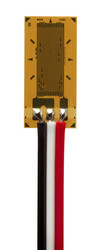
Ceralite is a piezoresistive sensor on a ceramic base.
It is rugged, corrosion and abrasion resistant which
makes it particularly suitable for industrial OEM applications.
These sensors have a wide operating temperature range
of -40°C to 125°C combined with high stability
and accuracy. These features make them ideal for process
control purposes in automatic machinery and instrumentation.
Ceralite allows direct contact of the fluid with the measuring cell and is
easy to handle. Its small 18 mm diameter allows for easy installation into almost all applications. Due to the special
monolithic sensor design, they are available as relative pressure cells between 2 to 100** bar.
The piezoresistive effect can be observed in a great
variety of materials. On Ceralite, a special proprietary
piezoresistive material is applied onto a ceramic diaphragm
by using thick film techniques. This gives high sensitivity
and stability over a wide temperature range.
The pressure acts directly on the front face of the
ceramic diaphragm. Therefore, almost any fluid can be
measured because ceramic offers unequaled resistance
against aggressive media. The screen-printed resistors
on the opposite face of the diaphragm are connected
to a closed Wheatstone bridge. The output from the bridge
is highly linear and the output signal is proportional
to the excitation voltage. The standard output signal
is untrimmed within 1.6 and 4.0 mV/V and is fully strain
gauge compatible.
• Monolithic ceramic cell design - improved stability and linearity
• Temperature compensated
• Trimmed zero balance
• Optional sensitivity trimmed
• Excellent corrosion and abrasion resistance
• Shock and vibration resistant
• Easy installation - one sensor thickness for all ranges
• Competitive price