|
Our
Products
Instrumentation
Monitoring/Display
Signal
Conditioning
Stress
Analysis
Strain
Gauges
Transducers
Load/Torque
Cells
Displacement
Pressure
Data
Acquisition
Vibration
Accelerometers
Analysis
Physical Testing
Material/Composite
Fatigue/Durability
Physical
Environmental
Test
Chambers
Our
Manufacturers
Ashcroft
Capacitec
Celesco
Chart
Cincinnati
Sub_Zero
Data
Physics
Data
Track
Doric
Ectron
GP:50
Honeywell
Kaman
Kistler
Lebow
Products
Michigan
Scientific
Morehouse
Non-Linear
Devices
Revere
Transducers
Sensortronics
SRI-PMD
Strainsert
Tedea-Huntleigh
Tovey
Trans-Tek
Unipulse
Vishay
Measurements Group
|
|
|
|
|
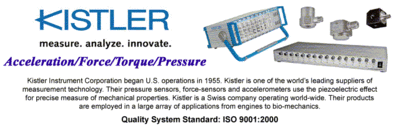
Kistler Acceleration/Force/Pressure
|

Kistler Acceleration Series
Kistler expands its sensor
product lines to cover all acceleration applications
With over 2200 cataloged products, Kistler offers
sensors across the entire acceleration spectrum.
Not only have many new individual sensors and
accessories been introduced in recent months,
but a new family of eight ceramic shear sensors,
featuring high output ceramic elements is now
available.
Accelerometer Families:
K-SHEAR® - General purpose, shock and high vibration; high or low temperature versions.
PiezoBEAM® - Modal and structural analysis.
K-BEAM® - Seismic studies, large structure measurements, biomechanics and more.
K-GUARD® - Monitoring of rotating machinery.
Ceramic Shear - Multichannel, OEM sensors that run the gamut of industrial, test and measurement,
R&D and OEM applications.
For a general overview of the comprehensive range of Kistler accelerometers, please request
their well documented, easy to read catalogue, which provides comprehensive information on all Kistler products for
the measurement of acceleration. Learn why many users are choosing Kistler for their Structural Testing, Automotive/Transportation,
Environmental Stress, Screening, Aerospace and Military applications, Hot or Cold, Static to High Frequency.
|
|

Kistler Force
Series
Force, like any other physical phenomena, cannot be measured without disturbing the phenomenon being measured. Most force
sensors have an elastic sensing element, whose deformation is a measure of the acting force.
In many force
measurement systems (i.e. strain gauges, inductive and capacitive systems), this deformation itself must be measured. The
sensing element must have enough compliance to provide sufficiently large deformation and hence useful sensitivity. These
large deformations are undesirable because they limit the frequency response of the measuring system and also introduce
geometric changes into the force measuring path which inevitably leads to measurement errors (i.e. linearity and hysteresis).
In piezoelectric force sensors the sensing element
is the same as the transaction element which produces
the electrical output signal from an acting force.
Therefore, it is not necessary to measure the
deformation (which will be much smaller than with
other measuring systems). The resultant high rigidity
of piezoelectric force sensors greatly reduces
the disturbance (or geometric changes) caused
by the measurement and provides an inherently
high natural frequency and associated rise time.
This permits the measurement of extremely fast
events (such as shock waves in solids, impact
printer and punch press forces) that otherwise
might not be possible.
While piezoelectric force sensors are ideally
suited for measuring dynamic events, they cannot
perform truly static measurements. Although the
electrical charge delivered under a static load
can be registered, it cannot be stored for an
indefinite period of time. For static measurements,
highly insulated materials must be used for the
sensor cables and connectors to insure a maximum
discharge time constant and optimal operation
of the charge amplifier (i.e. minimal draft).
Quartz is used in all Kistler force sensor designs.
Since it has an ultra high insulation resistance,
static measurements are more feasible with quartz
than with any other piezoelectric material. In
fact, quartz -based piezoelectric systems can
routinely measure large forces for minutes and
perhaps even hours. Low level forces can be measured
"statically" for much shorter intervals. This
is why Kistler piezoelectric force sensors are
often described as being "quasistatic."
PIEZOTRON® force sensors use the same quartz
sensing element as standard (charge output) piezoelectric
units and also have a miniature, built-in charge-to-voltage
converter for low impedance voltage output. This
allows the usage of general purpose cable in environments
where moisture or contamination would be detrimental
to the high insulation resistance required with
high impedance sensors. PIEZOTRON force sensors
have time constants long enough for calibration,
but usually not long enough for static measurements.
For this reason they are usually restricted to
dynamic applications.
Applications:
Material testing, impact forces
Machinery and assembly tests
Insertion, extraction monitoring
Component insertion
Bearing reaction, machinery testing
Bolt, clamping and punch press forces
Features:
Compression and tension
Preloaded assembly
High rigidity, easy installation
Force ranges to 270,000 lb.
Wide measuring range (1 to 1,000,000)
|

Kistler Pressure
Series
Pressure Transducers - Pressure Sensors Piezoelectric & Piezoresistive
Quartz is the heart of Kistler piezoelectric pressure sensors. Its characteristics of long-term stability, high
rigidity and strength, wide measuring range and wide temperature range make it the ideal sensing element for dynamic
pressure sensors. Pressure measurements with ranges up to 150,000 psi, temperatures up to 660°F, rise times of 1 microsec,
and resonant frequencies up to 500 kHz are all possible with Kistler piezoelectric pressure sensors.
While quartz-based pressure sensors are ideally
suited for measuring dynamic events, they cannot
perform truly static measurements. Although the
electrical charge delivered under a static load
can be registered, it cannot be stored for an
indefinite period of time. For static measurements,
highly insulated materials must be used in the
sensor's cables and connectors to insure a maximum
discharge time constant and optimal operation
of the charge amplifier(i.e. minimal drift). Since
quartz has a very high insulation resistance,
short-term static pressure measurements are more
feasible than with any other piezoelectric material.
Quartz-based piezoelectric systems can routinely
measure large pressures for minutes and perhaps
even hours. Low level pressures can be measured
"statically" for much shorter intervals. For this
reason Kistler piezoelectric pressure sensors
are often described as being "quasistatic."
PIEZOTRON® pressure sensors use the same quartz
sensing element as standard (charge output) piezoelectric
units and also include a miniature, built-in charge-to-voltage
converter for low impedance voltage output. This
allows the usage of general purpose cable in environments
where moisture or contamination would be detrimental
to the high insulation resistance required with
high impedance sensors. PIEZOTRON pressure sensors
generally have time constants long enough for
calibration, but usually not long enough for static
measurements. For this reason they are usually
restricted to dynamic applications.
Kistler piezoresistive pressure sensors measure static and
dynamic events with high accuracy and long-term stability. Kistler's comprehensive line includes general purpose, industrial
and OEM sensors, along with specialty units for oil exploration, engine monitoring and liquid level sensing.
Kistler's
sensors utilize three types of proven sensing elements:
(1) Oil filled silicon measuring cells (2) Dry,
high pressure/high temperature silicon SOI elements (3) Ceramic sensors using thick film technology on a substrate.
The full scale pressure ranges cover 3 psi through 72,000 psi and temperatures from -50 to 570°F.
Piezoresistive
transducers require constant current excitation provided by Kistler's signal conditions (refer to catalogue).
Piezoresistive transmitters require only voltage excitation for proper operation. Models are available in 2 or 3 wire
configurations. Some versions not only provide pressure information, but can also measure temperature using appropriate
Kistler amplifiers.
Request data bulletins or call us for complete details.
|

Kistler Torque
Series
Kistler announces the availability of new high performance torque sensors for production and laboratory
use within automotive, aerospace and test and measurement applications. Models available include
Type 4501A, Type 4502A, Type 4503A and Type 4504A.
Kistler Instrument Corp. calibration laboratories are ISO/IEC 17025 Accredited. They recommend annual
sensor calibration service to maintain precise data of the highest integrity.
|
|

Kistler
Accessories & Instrumentation
Cables - Calibration - Electronics - Mounting
Preloading - Measuring Instruments
Monitoring Control - Signal Conditioners
Kistler accessories and instrumentation products are used in a wide range of applications such as,
engines, vehicles, manufacturers, plastics and biomechanics.
We wish you every success
with Kistler Measurement Instrumentation products and thank you for your confidence and interest.
|
|
|
|
|